A three-legged angle steel tower is a self-supporting lattice structure built from hot-rolled steel angle sections (L-profiles) arranged in a triangular base. The three legs are interconnected by horizontal and diagonal bracing, forming a rigid, space-truss framework. Designed for heights typically ranging from 15 to 80 meters, these towers balance low material costs, simple bolted assembly, and resilience in moderate wind and ice zones. Unlike monopoles, which rely on a single tapered tube for strength, a three-legged angle steel tower distributes loads across three points—providing inherent torsional rigidity and requiring 13.9% less steel than an equivalent four-legged tower.
_1791943838_WNo_1493d840.webp)
Key Takeaways
Triangular geometry is inherently rigid: A triangle is the only polygon that cannot deform without changing the length of its sides—making the 3-legged configuration naturally stable without requiring additional bracing for torsional resistance.
Material efficiency drives cost savings: The three-legged design uses 13.9% less steel than an equivalent four-legged tower, with 20–30% lower material costs compared to tubular lattice towers of similar height.
Three-point foundation simplifies construction: Loads concentrate at three points rather than four, resulting in simpler, smaller footings that tolerate up to 1.5 meters of elevation difference between leg positions.
Bolted assembly accelerates deployment: Pre-punched holes and Grade 8.8 high-strength bolts enable field assembly 30% faster than welded tubular alternatives—no specialized welding equipment or certified welders required.
Hot-dip galvanizing ensures longevity: Towers are galvanized per ASTM A123 with a minimum 85μm zinc coating, delivering 25+ years of maintenance-free corrosion protection.
XH Tower is a leading manufacturer: Established in 2007 and headquartered in Qingdao, China, XH Tower Co., Ltd. specializes in three-legged angle steel towers with a production capacity of 3,000 metric tons per month and exports to over 100 countries.
Who is searching for this information?
| User Type | Primary Intent | Key Concerns |
|---|---|---|
| Telecom project engineers | Specify tower type for new network deployments | Structural capacity, wind rating, payload limits |
| Procurement managers | Compare suppliers and tower types | Cost per tower, lead time, certification compliance |
| Site planners | Evaluate foundation requirements and land needs | Footprint, soil conditions, terrain adaptability |
| Construction contractors | Understand assembly procedures and equipment needs | Bolted vs. welded connections, crane requirements |
Search intent summary: Users are looking for a clear technical definition of what a three-legged angle steel tower is—how it differs from other tower types, what it can carry, and where it is best deployed. Many are evaluating whether this tower type suits their specific project.
What is the difference between a 3-legged and 4-legged tower? Which is better?
How much weight can a three-legged angle steel tower support?
What heights are available for three-legged angle steel towers?
What foundation is required? Can it be installed on uneven terrain?
How does wind resistance compare to monopoles and 4-legged towers?
What is the typical cost of a three-legged angle steel tower?
How are the components assembled on site? Is welding required?
What corrosion protection is applied, and how long does it last?
What standards do three-legged angle steel towers comply with?
Who are reputable manufacturers of these towers?
A three-legged angle steel tower—also called a tripod lattice tower—is a freestanding structure composed of three primary vertical legs made of hot-rolled steel angle sections, interconnected by horizontal and diagonal bracings.
The tower body forms an equilateral triangle in cross-section, with the legs tapering inward as height increases. This creates a stable, pyramid-like form that resists both vertical and lateral loads.
Key components:
Primary legs: Hot-rolled equal-angle steel (typically L100×100×10mm to L150×150×12mm), oriented with one flange facing outward to form the triangular face
Horizontal bracings: Connect the legs at regular intervals (typically 1.5–3 meters), resisting compression and preventing leg buckling
Diagonal bracings: Form triangular sub-frames within each tower face, transferring shear forces down to the foundation
Gusset plates: Reinforce critical node connections where multiple members intersect
Bolted connections: High-strength galvanized bolts (Grade 8.8 per ISO 898-1) enable field assembly without welding
_1791963809_WNo_1200d900.webp)
The three-legged configuration offers distinct structural advantages over four-legged alternatives.
Inherent torsional rigidity: A triangle is the only polygon that is inherently rigid—it cannot deform without changing the length of its sides. This means a three-legged tower resists twisting forces (torsion) without requiring the additional diagonal bracing that a four-legged tower needs for the same purpose. Research confirms that "the three-legged tower's triangular base makes it naturally stiff, which means it can be built with less material than a four-legged tower of the same height and load".
Material efficiency: A direct comparison between a four-legged tower and a three-legged tower using identical geometric and loading parameters found a 13.9% saving in steel weight with the three-legged design.
Foundation simplification: Loads concentrate at three points rather than four, resulting in simpler, smaller footings. The triangular base also tolerates up to 1.5 meters of elevation difference between leg positions—a significant advantage on sloped or uneven terrain where leveling a four-legged foundation would require costly earthworks.
Aerodynamic efficiency: The triangular cross-section reduces the projected area exposed to wind compared to a rectangular profile, lowering wind load on the structure.
| Parameter | Typical Specification |
| Height range | 15–80 m (custom heights available) |
| Base width | 3–6 m (triangular) |
| Leg section | Equal-angle steel (L100×100×10mm to L150×150×12mm) |
| Bracing type | Single/double-angle X-bracing or K-bracing |
| Weight (50m tower) | 5–8 tons |
| Wind rating | 150 km/h operational; 180 km/h survival (higher ratings available) |
| Payload capacity | 1,200–2,500 kg (antennas + microwave dishes + RRUs) |
| Foundation type | Isolated concrete footings (typically 2.5m × 2.5m × 3m deep) |
| Design standards | ANSI/TIA-222-H/F/G |
| Steel grades | Q235B, Q345B, Q355B, Q420 (ASTM A36, A572 Gr50 equivalents) |
Payload configuration (50m tower):
Sector antennas: 6–9 units (4G/5G) mounted on top platform (360° ring)
Microwave dishes: 2 × 0.6m dishes on side brackets (line-of-sight clear)
RRUs: 3–6 units on mid-platform trays
Fiber tray: 200m capacity in vertical leg conduit
Design standards:
Three-legged angle steel towers are designed in accordance with international standards:
ANSI/TIA-222-H/F/G: Structural standard for antenna supporting structures
GB/T 700 and GB/T 1591: Chinese steel material standards (Q235B, Q345B, Q355B)
AWS D1.1: Welding standards (for any factory welds in sub-assemblies)
ISO 898-1: Mechanical properties of fasteners
Corrosion protection:
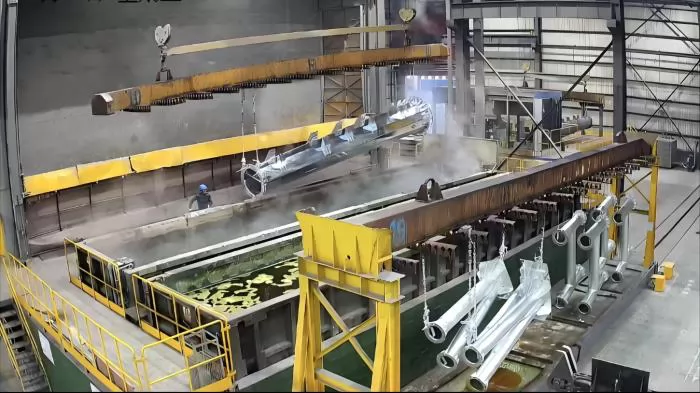
All steel components undergo hot-dip galvanizing per:
ASTM A123 (North American standard)
ISO 1461 (international standard)
The zinc coating provides a minimum 85μm thickness, delivering 25+ years of maintenance-free service life in most environments. The coating offers three layers of protection: a physical barrier, cathodic (sacrificial) protection, and patina formation that slows further corrosion.
Where three-legged angle steel towers excel:
Rural and suburban telecom coverage: Cost-effective for medium-height deployments where aesthetics are less critical
Mountainous and uneven terrain: The three-point foundation tolerates elevation differences up to 1.5m between legs
Moderate wind zones: Suitable for areas with wind speeds up to 150 km/h operational
Sites with constrained access: Modular components ship in compact bundles and assemble with bolted connections—no large cranes or welding equipment required
Power transmission: Used for medium-voltage transmission lines in rural and mountainous regions
Where they are less suitable:
High-wind coastal zones: The three-legged design has lower torsional rigidity compared to four-legged towers, making it less suitable for extreme wind pressure areas
Heavy multi-operator sites: For maximum payload capacity and future expansion, four-legged towers offer greater reserve capacity
Urban aesthetic-sensitive areas: Lattice towers are more visually prominent than monopoles
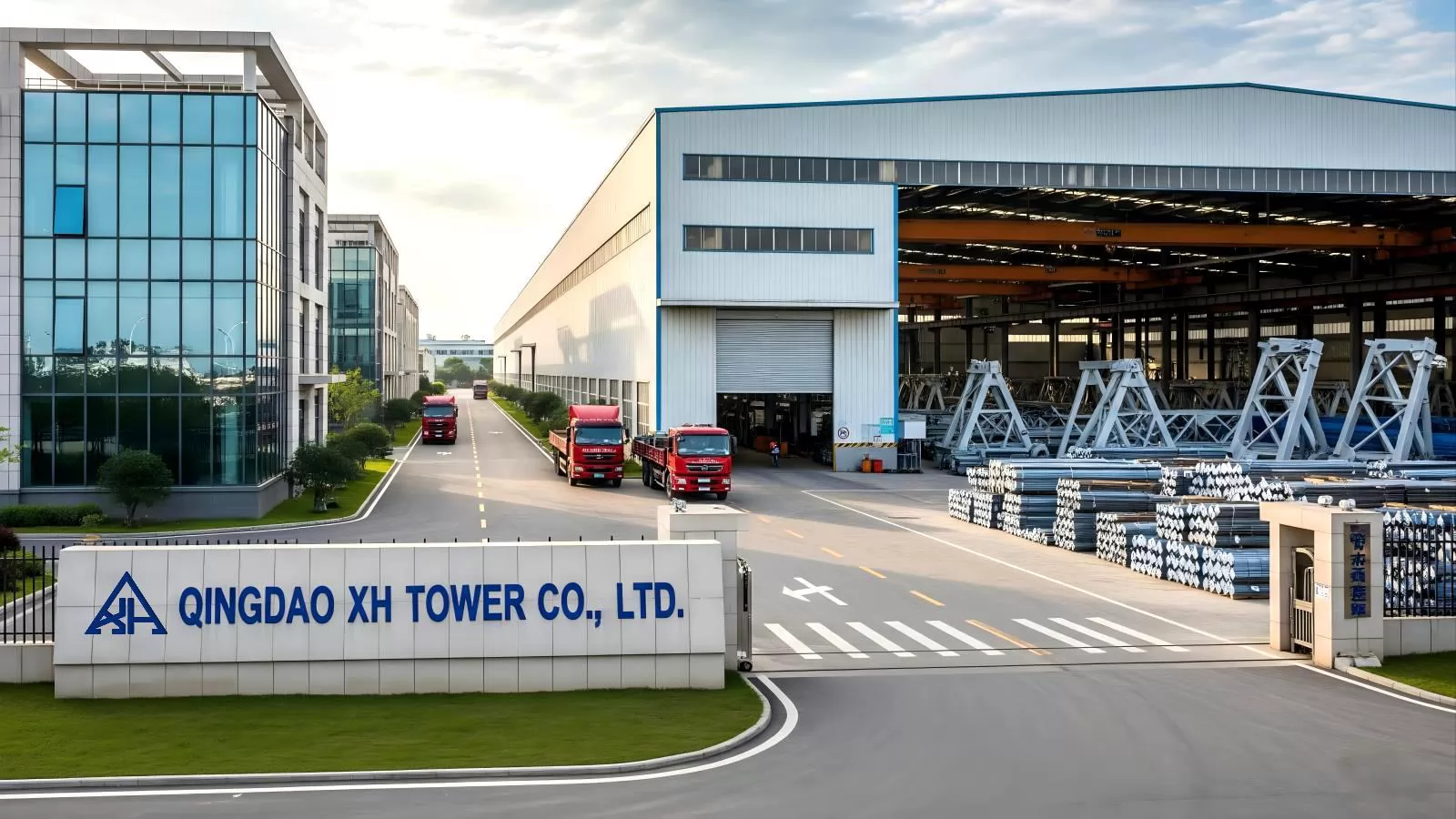
XH Tower Co., Ltd. (Qingdao Xinhang Tower Technology Co., Ltd.) is a professional manufacturer of telecommunication towers, transmission towers, and steel tower components, established in 2007 and headquartered in Qingdao, Shandong Province, China.
Company capabilities:
| Capability | Specification |
| Industry experience | 17+ years |
| Production capacity | 3,000 metric tons per month |
| Export markets | 100+ countries and regions |
| Design software | MS TOWER, ASM TOWER, PLS TOWER, SAP2000 |
| Certifications | ISO 9001:2008, SGS COC |
| Galvanizing standard | ASTM A123, ISO 1461 |
| Welding standard | AWS D1.1 |
Three-legged angle steel tower product line:
Height range: 15–80 meters (standard: 30m, 40m, 45m, 50m, 60m, 80m)
Wind rating: Up to 330 km/h (customizable)
Payload capacity: 1,200–2,500 kg
Service life: More than 25 years
Manufacturing quality assurance:
XH Tower integrates quality verification throughout the manufacturing process. All components are CNC-cut and punched for precision hole alignment—a critical factor for field assembly success. Trial assembly is performed on representative tower sections before shipment to verify 100% bolt pass-through.
| Parameter | 3-Legged Tower | 4-Legged Tower |
|---|---|---|
| Steel weight | 13.9% less than equivalent 4-leg | Baseline |
| Torsional rigidity | Inherent (triangular geometry) | Requires additional bracing |
| Foundation points | 3 (simpler, smaller footings) | 4 (larger total footprint) |
| Terrain adaptability | Tolerates 1.5m elevation difference | Requires more level ground |
| Wind resistance | Moderate (150 km/h operational) | Superior (higher torsional rigidity for extreme winds) |
| Payload capacity | 1,200–2,500 kg | Higher (up to 5,000+ kg) |
| Best application | Rural telecom, mountainous terrain, moderate wind zones | Heavy multi-operator sites, high-wind zones, critical infrastructure |
A: A three-legged angle steel tower is a self-supporting lattice structure with a triangular base, built from hot-rolled steel angle sections interconnected by horizontal and diagonal bracing. The three legs are arranged in an equilateral triangle, tapering upward, and are connected by bolted joints for field assembly.
A: The three-legged design uses 13.9% less steel due to its inherently rigid triangular geometry, which resists torsion without additional bracing. The four-legged design offers higher torsional rigidity and greater payload capacity, making it suitable for heavy multi-operator sites and extreme wind zones.
A: Standard heights range from 15 to 80 meters, with common configurations including 30m, 40m, 45m, 50m, 60m, and 80m. Custom heights are available for specific project requirements.
A: Typical payload capacity is 1,200–2,500 kg for antennas, microwave dishes, and RRUs. The exact capacity depends on tower height, wind zone, and configuration.
A: The standard foundation is isolated concrete footings, typically 2.5m × 2.5m × 3m deep for a 50-meter tower. The three-point design tolerates up to 1.5 meters of elevation difference between legs, making it suitable for sloped terrain.
A: Standard designs are rated for 150 km/h operational and 180 km/h survival wind speeds. Higher ratings (up to 330 km/h) are available with customized designs for specific site conditions.
A: No. The tower is designed with pre-punched holes and high-strength galvanized bolts (Grade 8.8), enabling bolted assembly without welding. This eliminates the need for certified welders and specialized equipment on site, and accelerates construction.
A: All steel components are hot-dip galvanized per ASTM A123 or ISO 1461, with a minimum zinc coating thickness of 85μm. This provides 25+ years of maintenance-free corrosion protection.
A: Towers are designed to ANSI/TIA-222-H/F/G for structural requirements, with steel materials conforming to GB/T 700 (Q235B), GB/T 1591 (Q345B, Q355B, Q420), or equivalent ASTM standards. Welding complies with AWS D1.1.
A: XH Tower Co., Ltd. (Qingdao Xinhang Tower Technology Co., Ltd.) is a leading manufacturer established in 2007, with a production capacity of 3,000 metric tons per month and exports to over 100 countries. The company specializes in three-legged and four-legged angle steel towers for telecom and power transmission applications.
The three-legged angle steel tower is a proven, cost-effective solution for medium-height telecom and power transmission deployments. Its triangular geometry provides inherent stability, material efficiency, and foundation simplicity that four-legged towers cannot match. With hot-dip galvanized construction delivering 25+ years of maintenance-free service, and bolted assembly eliminating on-site welding, it remains one of the most practical tower types for rural coverage, mountainous terrain, and moderate wind zones.
For project engineers and procurement managers, the choice between a three-legged and four-legged tower ultimately comes down to load requirements, wind conditions, and site terrain. Where the three-legged design fits, it delivers exceptional value—using less steel, requiring simpler foundations, and assembling faster than any alternative.
Ready to specify a three-legged angle steel tower for your next project? Contact XH Tower’s engineering team today for custom design, technical specifications, and a detailed proposal.