
How the Steel Lattice Tower Manufacturers Were Evaluated
List of Top Steel Lattice Tower Manufacturers
Steel lattice towers have long been a foundational structure in telecommunications, broadcasting, and utility infrastructure across the United States. Despite the growing adoption of monopoles and concealed tower designs in urban environments, steel lattice towers continue to play a critical role in projects that require greater height, higher load capacity, and enhanced wind resistance, particularly in rural, coastal, and high-wind regions.
In 2026, demand for steel lattice towers in the U.S. is driven by several parallel factors. These include ongoing 5G network expansion, the replacement or reinforcement of aging infrastructure, rural broadband initiatives, and increased requirements for structural compliance with updated engineering standards. Compared with tubular monopoles, lattice towers often provide a more cost-effective solution for tall structures and multi-antenna configurations, especially where land availability is not a limiting factor.
From a lifecycle perspective, steel lattice towers are designed as long-term infrastructure assets, with typical service lives exceeding 25 years when properly engineered, manufactured, and maintained. As a result, the choice of manufacturer has a direct impact not only on upfront project costs, but also on long-term safety, compliance, and operational reliability.
This article is intended for professionals and organizations involved in the planning, procurement, and execution of large-scale infrastructure projects, including:
Telecommunications operators and network planners
EPC contractors and infrastructure developers
Utility companies and public-sector procurement teams
International buyers sourcing steel lattice towers from U.S.-based manufacturers
To avoid confusion and ensure clarity, it is important to note that this list focuses exclusively on steel lattice tower manufacturers. It does not include tower owners, leasing companies, or passive infrastructure operators whose primary business model is site ownership rather than structural fabrication.
The purpose of this ranking is not to declare a single “best” manufacturer, but to provide a structured, fact-based overview of leading U.S. manufacturers with demonstrated capabilities in steel lattice tower production. Each company included in this list has been selected based on publicly available information related to manufacturing focus, engineering capability, standards compliance, and industry presence.
Because steel lattice towers are custom-engineered structures rather than off-the-shelf products, traditional product testing or consumer-style reviews are not applicable. Instead, this guide emphasizes verifiable criteria such as manufacturing scope, technical specialization, and typical application areas to help readers identify manufacturers that align with their specific project requirements.
By presenting this information in a transparent and structured format, this article aims to serve as a practical reference for buyers and project stakeholders evaluating steel lattice tower manufacturing options in the United States in 2026.
A lattice tower is a type of self-supporting or guyed structure characterized by an open-frame, truss-based design. Instead of using solid walls or tubular sections, lattice towers rely on interconnected steel or metal members arranged in triangular patterns to efficiently distribute loads.
The term lattice tower refers specifically to the structural form, not the construction material. This design approach has been widely used for decades in applications where height, load capacity, and structural stability are critical.
Typical structural configurations include:
Three-legged lattice towers
Four-legged lattice towers
These configurations allow engineers to balance strength, weight, and foundation requirements while maintaining structural redundancy.
Because of their structural efficiency, lattice towers are commonly used in:
Telecommunications networks (macro cell sites)
Broadcasting and television transmission
Power transmission and utility infrastructure
Observation, meteorological, and monitoring structures
In many of these applications, lattice towers are selected for their ability to support heavy equipment loads at significant heights while maintaining long-term reliability.
While the lattice design itself is material-agnostic, several materials have been used historically:
Steel – the most widely used material due to its strength, durability, and cost-effectiveness
Aluminum – used in limited, lightweight or temporary applications
Hybrid or composite materials – rare and typically reserved for specialized use cases
Among these options, steel has become the dominant material for lattice towers in modern infrastructure projects.
A steel lattice tower is a specific type of lattice tower in which structural steel components are used as the primary construction material. It combines the geometric efficiency of the lattice structure with the mechanical strength and durability of steel.
Steel lattice towers are typically fabricated using:
Angle steel sections
Steel plates and connection components
High-strength bolts or welded joints
The modular nature of steel components allows towers to be manufactured in sections, transported efficiently, and assembled on site.
Steel lattice towers are widely used in projects that require:
Tall, self-supporting telecommunications towers
High-power broadcasting and transmission structures
Utility and power transmission towers
Installations in high-wind, remote, or challenging environments
Their structural configuration makes them particularly suitable for applications where monopole or tubular towers may be impractical due to height, load, or cost constraints.
From an engineering perspective, steel lattice towers differ from other common tower types in several key ways:
Compared to monopole towers, steel lattice towers typically offer greater height potential and load capacity, though they require a larger foundation footprint.
Compared to tubular steel towers, lattice structures use less material for equivalent height and load, improving material efficiency.
Compared to guyed towers, self-supporting steel lattice towers do not rely on guy wires, making them suitable for sites with limited surrounding land availability.
These characteristics make steel lattice towers a preferred choice for many large-scale and long-term infrastructure projects.
Selecting steel lattice tower manufacturers for this article was based on a structured evaluation process rather than product testing or subjective ranking. Because steel lattice towers are large-scale infrastructure assets with long service lives, hands-on testing is neither practical nor representative of real-world performance.
Instead, manufacturers were assessed using publicly verifiable information, industry-relevant criteria, and manufacturing-focused capabilities to ensure that the list provides practical value for engineers, project planners, and procurement professionals.
To maintain clarity and relevance, this article focuses exclusively on manufacturers that design and fabricate steel lattice towers. Companies whose primary business models center on tower ownership, leasing, or network operation were excluded.
Manufacturers were considered for inclusion only if they met the following baseline criteria:
Demonstrated experience in producing steel lattice towers
Active involvement in telecommunications, utility, or broadcasting infrastructure projects
Publicly available information regarding manufacturing capabilities and standards compliance
This approach ensures that all listed companies are evaluated within the same functional and technical scope.
Manufacturers were evaluated based on a set of criteria commonly used by industry professionals when assessing tower suppliers.
1. Manufacturing Focus and Product Scope
Priority was given to manufacturers with a clear and sustained focus on steel lattice tower fabrication. This includes the ability to produce common lattice configurations, such as three-legged and four-legged towers, across a range of heights and load requirements.
2. Engineering and Design Capability
Evaluation considered whether manufacturers demonstrate in-house or integrated engineering capabilities, including structural design, load analysis, and project-specific customization. Public references to design practices, engineering teams, or structural software usage were considered where available.
3. Standards and Regulatory Compliance
Compliance with recognized standards is a critical requirement for steel lattice towers. Manufacturers were evaluated based on their stated adherence to relevant U.S. and international standards, such as:
TIA-222 for telecom tower structural design
ASTM standards for structural steel and galvanization
Applicable ANSI or regional engineering requirements
Only manufacturers that publicly acknowledge compliance with established standards were included.
Manufacturing scale, fabrication processes, and quality assurance practices were reviewed based on publicly available descriptions. This includes factors such as:
Fabrication and assembly capabilities
Galvanization or corrosion protection processes
Quality control and inspection procedures
No assumptions were made beyond what manufacturers disclose through official channels.
Rather than focusing on company size alone, evaluation considered the relevance and consistency of industry participation. Manufacturers with documented experience across telecom, utility, or broadcasting sectors were favored, particularly those involved in long-term or repeat infrastructure projects.
All evaluations were based on information available from sources such as:
Official company websites and technical literature
Public project references or case descriptions
Industry publications and standards documentation
No proprietary data, confidential pricing information, or undisclosed performance metrics were used in the selection process.
This article does not represent a performance ranking, endorsement, or guarantee of suitability for any specific project. Manufacturers are presented to illustrate the range of steel lattice tower fabrication capabilities available in the U.S. market in 2026.
Project requirements vary significantly depending on location, load conditions, regulatory environment, and deployment objectives. Readers are encouraged to conduct project-specific evaluations and request detailed technical documentation before selecting a manufacturer.
While U.S.-based steel lattice tower manufacturers play an essential role in domestic telecommunications and utility infrastructure, project requirements can vary significantly depending on location, volume, and applicable standards.
For international deployments, multi-country network rollouts, or cost-sensitive projects, buyers may also evaluate export-oriented manufacturers with experience in supplying steel lattice towers beyond the U.S. market. In these cases, factors such as familiarity with multiple design standards (including ANSI, EN, and project-specific requirements), large-scale fabrication capacity, and overseas logistics coordination often become part of the sourcing decision.
XH Tower operates as an international steel lattice tower manufacturer supporting telecom and utility projects worldwide, offering fabrication and export services aligned with global project requirements.
Learn more about international steel lattice tower manufacturing options

Valmont Industries is a U.S.-based company with decades of involvement in infrastructure-related steel structure manufacturing. Its operations include supplying engineered steel structures for telecommunications, utility, and power transmission applications.
Valmont manufactures steel lattice towers, including self-supporting and guyed configurations, designed for telecommunications and utility infrastructure.
The company supports structural engineering, fabrication, and corrosion protection processes as part of its manufacturing operations, based on publicly described capabilities.
Valmont publicly references design and fabrication practices aligned with applicable U.S. and international standards for steel structures and telecommunications towers.
Telecommunications macro tower infrastructure
Utility and transmission-related steel structures
Long-term infrastructure projects
Commonly considered for large-scale infrastructure projects requiring established manufacturing processes and compliance-driven design.

Sabre Industries is a U.S.-based manufacturer operating in the communications and utility infrastructure sector, with a business focus on engineered steel structures.
The company produces steel lattice towers in various configurations, supporting telecommunications, broadcasting, and utility applications.
Sabre offers in-house engineering support and fabrication services tailored to project-specific structural requirements, as described in public materials.
The company references design practices aligned with standards such as TIA-222 and applicable ASTM specifications.
Telecom network expansion projects
Broadcasting transmission towers
Utility infrastructure
Typically selected for projects requiring custom-engineered lattice towers with defined load and site conditions.
Rohn Products is a U.S.-based manufacturer with a long history of producing steel towers for communications and broadcasting applications.
Rohn supplies steel lattice towers in standardized and configurable designs, including three-legged and four-legged structures.
The company emphasizes repeatable fabrication processes and standardized tower designs to support consistent production.
Products are designed in alignment with applicable U.S. telecommunications and structural standards.
Broadcasting tower installations
Telecommunications infrastructure
Rural and regional deployments
Often considered for projects that prioritize standardized lattice tower designs with established deployment history.
RS Technologies operates within the infrastructure manufacturing sector, supplying steel structures for communications, utility, and transportation-related projects.
The company manufactures steel lattice towers and related structural components used in telecommunications and utility applications.
RS Technologies supports structural design, fabrication, and protective coating processes within its infrastructure manufacturing operations.
Public documentation references alignment with applicable structural and material standards.
Telecommunications infrastructure
Utility and multi-sector steel structure projects
Commonly considered for projects requiring integrated steel structure manufacturing across multiple infrastructure sectors.
Nello Corporation is a U.S.-based manufacturer specializing in engineered steel structures for telecommunications and utility markets.
The company produces steel lattice towers designed to support telecommunications and related infrastructure equipment.
Nello offers custom fabrication options and project-specific engineering support based on publicly stated capabilities.
Manufacturing practices are described as aligned with relevant U.S. structural and telecommunications standards.
Telecom network infrastructure
Utility and industrial tower applications
Typically selected for projects requiring custom-fabricated lattice towers adapted to specific site and load conditions.
Universal Towers is a U.S.-based manufacturer focused on the fabrication of communication tower structures and related steel components.
The company supplies steel lattice towers and tower components for telecommunications applications.
Universal Towers supports both standard and customized tower fabrication based on project requirements.
Products are designed in accordance with applicable U.S. telecommunications and structural standards.
Telecommunications tower installations
Regional and site-specific deployments
Often considered for small to mid-scale telecom projects requiring lattice tower fabrication support.
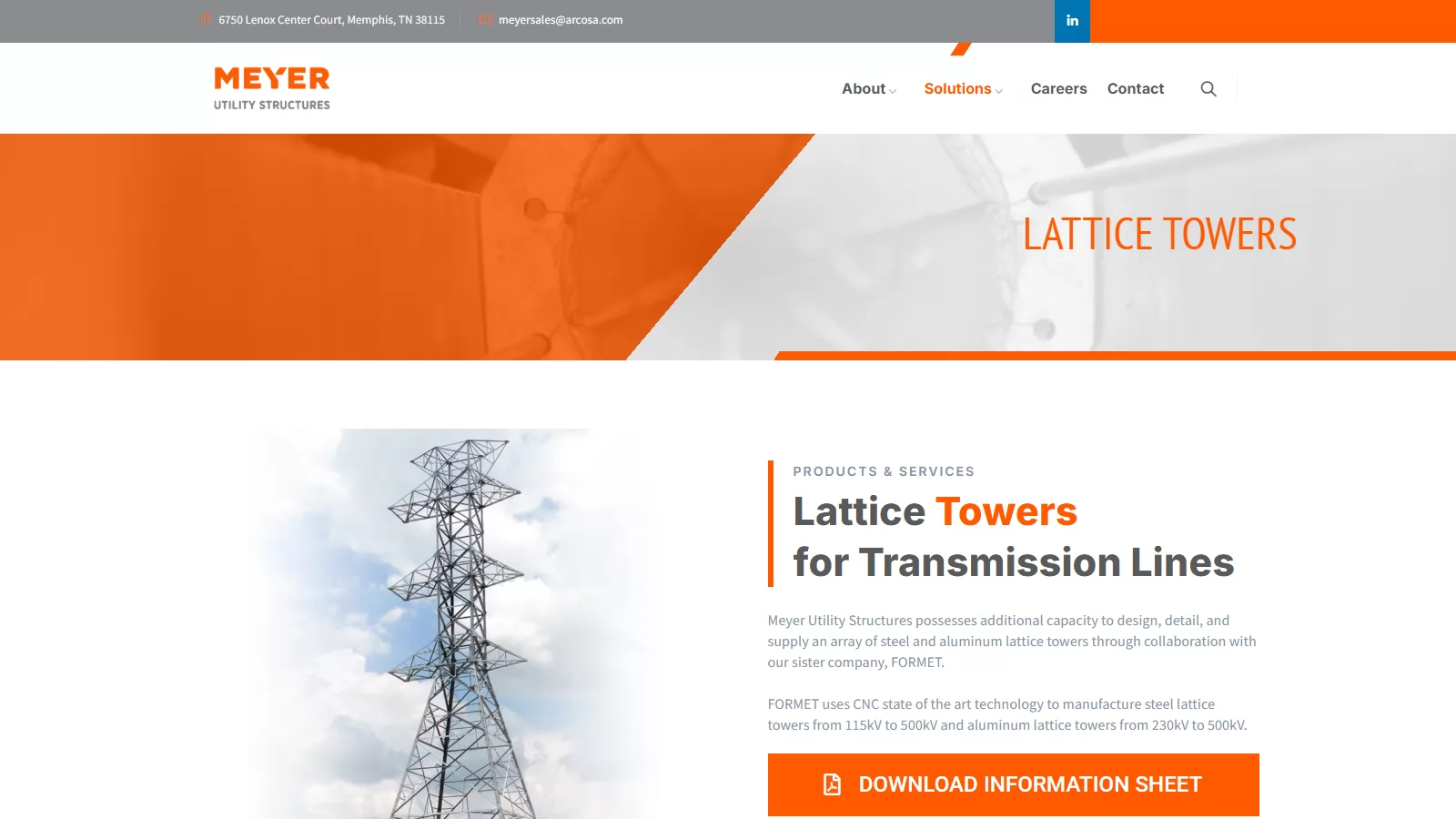
Meyer Utility Structures, LLC is a U.S.-based structural manufacturer specializing in engineered steel infrastructure for transmission, distribution, and related applications. The company has roots dating back over six decades in the utility and transmission structure sector and operates as part of the Arcosa, Inc. group of infrastructure-related businesses. Meyer is headquartered in Memphis, Tennessee, and its operations include structural design and fabrication for utility and lattice structures.
Meyer Utility Structures offers steel lattice towers designed for high-voltage transmission and distribution applications. Through collaboration with sister company FORMET, Meyer has capacity to design, detail, and supply steel lattice towers with configurations suitable for a range of utility voltages and infrastructure needs.
The company supports structural design, detailing, fabrication, and related engineering processes aligned with utility infrastructure requirements. Meyer describes in-house engineering support combined with manufacturing practices that consider environmental impacts and project specifications.
Meyer Utility Structures references ISO 9001:2015 certification and compliance with recognized structural and manufacturing quality standards such as ASTM, AWS, and ASCE guidelines for steel structures. These references indicate adherence to widely recognized industry practices in structural fabrication and quality assurance.
Utility transmission and distribution lattice towers
Engineered poles and structural infrastructure
Substation steel structures
Light-duty lattice configurations such as TOWERpole systems
Meyer Utility Structures is commonly considered for infrastructure projects requiring engineered steel lattice towers and utility structures, particularly where established manufacturing processes and adherence to recognized structural standards are important.
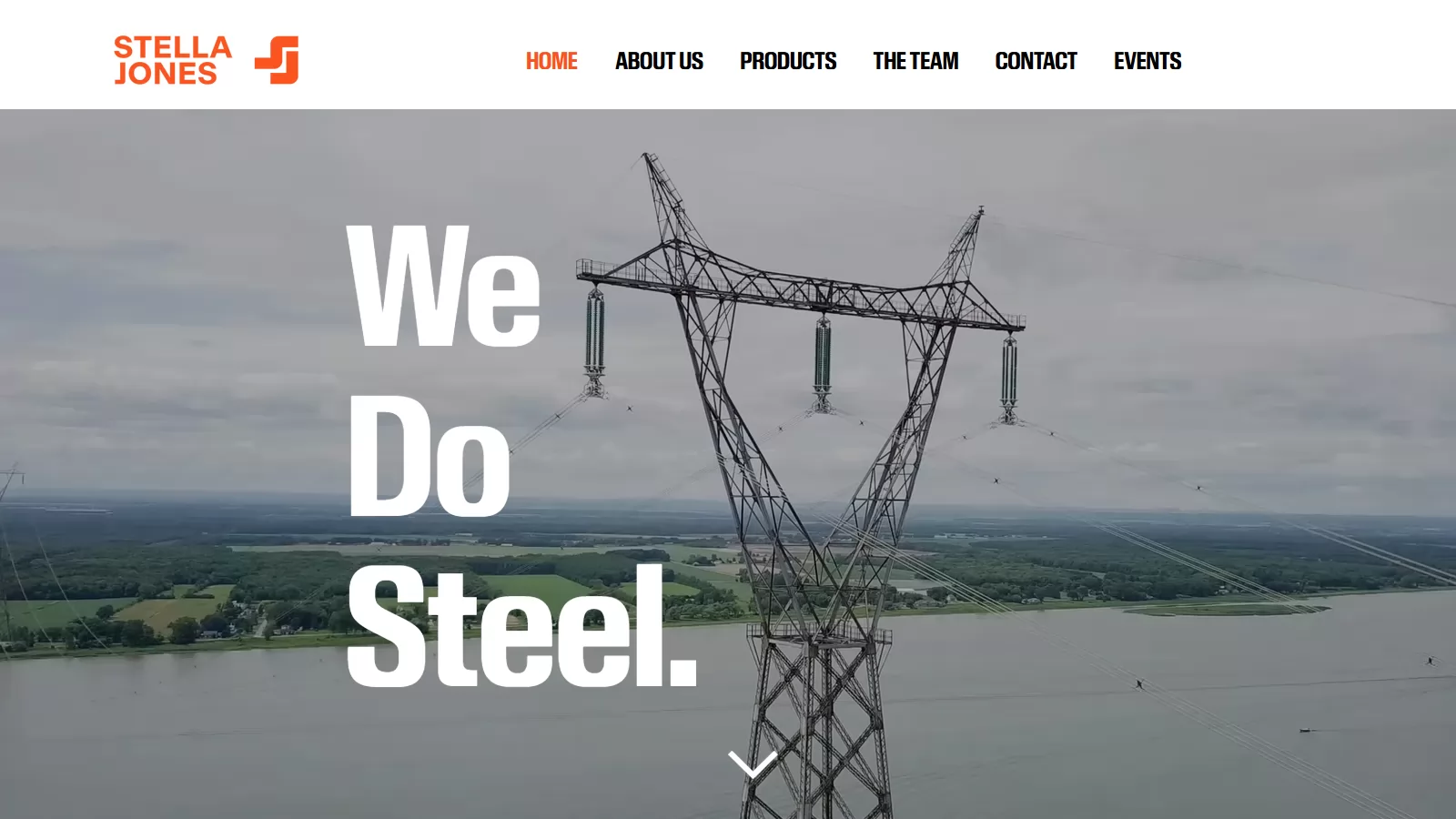
Stella-Jones Steel Structures refers to the steel infrastructure manufacturing activities of Stella-Jones Inc., a North American infrastructure products company. In 2025, Stella-Jones expanded into the steel transmission structures sector through its acquisition of Locweld Inc., a manufacturer of lattice transmission towers and steel poles. This strategic move established Stella-Jones’ presence in the steel lattice tower market and broadened its infrastructure offerings within the United States and Canada.
Stella-Jones Steel Structures produces steel lattice tower solutions and related transmission structures. Products include self-supporting and guyed steel lattice towers designed to support electrical transmission and utility infrastructure. Fabricated lattice structures are intended to meet customer specifications for load requirements and site conditions.
The company’s steel structure operations draw on decades of expertise inherited from Locweld, with a manufacturing facility of approximately 220,000 square feet. Stella-Jones provides structural design support that includes load analysis and simulation, as well as steel fabrication processes such as cutting and welding. Quality control processes are conducted in alignment with industry standards, and trial assembly practices are used to help ensure fit-up prior to field installation.
Stella-Jones Steel Structures’ manufacturing practices are described in publicly available materials as aligned with applicable structural and telecommunications infrastructure standards. Fabrication and quality assurance are supported by certified programs intended to monitor compliance with customer and industry requirements.
Steel lattice towers for electrical transmission systems
Utility and high-voltage infrastructure support structures
Custom structural solutions for project-specific requirements
These products are used in projects serving electrical utilities and infrastructure industries across the United States and Canada.
Stella-Jones Steel Structures is commonly considered for infrastructure projects that require engineered steel lattice towers and transmission structures, particularly where integration with broader electrical grid support and utility deployment is a priority.
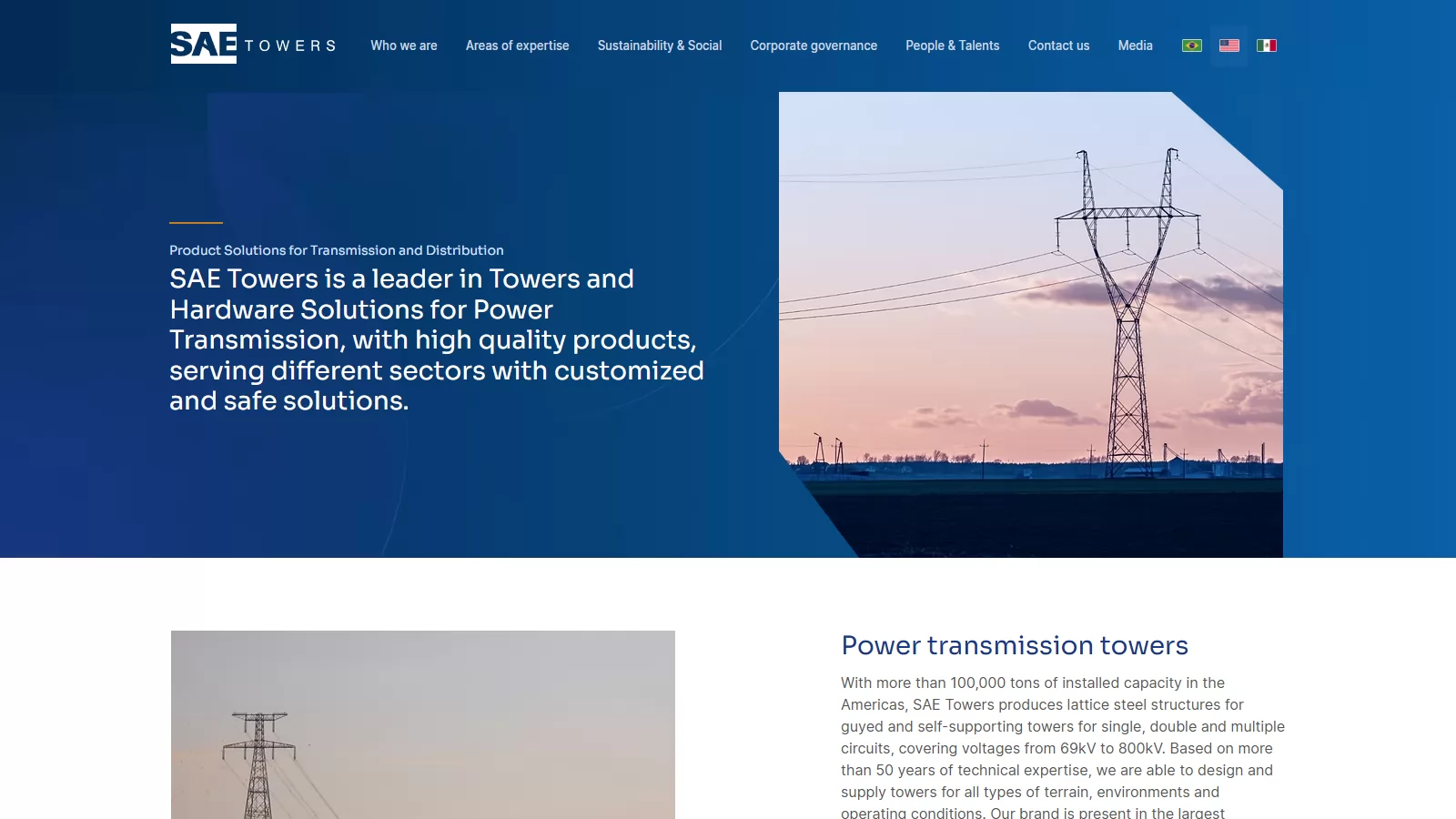
SAE Towers is a U.S.-headquartered company engaged in the design and manufacture of steel lattice tower solutions for power transmission, telecommunications, and related infrastructure applications. The company operates with manufacturing facilities in the United States, Brazil, and Mexico and is a wholly owned subsidiary of KEC International Limited, part of the RPG Enterprises Group, which has operations in more than 50 countries.
SAE Towers produces a range of steel lattice towers and related structural hardware. Its product offerings include lattice tower configurations suitable for telecommunication systems as well as high-voltage power transmission and distribution structures.
The company supports in-house project design, detailing, prototyping, testing, and manufacturing processes for steel lattice towers and associated components, based on publicly available descriptions of its operations. Production processes are reported to include modern fabrication techniques and protective coating systems to address structural and environmental requirements.
SAE Towers references manufacturing practices and quality systems aligned with internationally recognized standards, and its facilities reportedly hold certifications for quality and safety systems used in structural fabrication and supply chain operations. Specific standards alignment is communicated through its global parent organization’s quality framework.
Steel lattice towers for power transmission and distribution lines
Steel lattice support structures for telecommunications and related infrastructure
Structural solutions designed for diverse terrain and operating conditions within large-scale infrastructure projects
SAE Towers is commonly considered for projects requiring engineered steel lattice tower solutions across power transmission and telecommunications infrastructure, particularly where integrated design and manufacturing capabilities are aligned with operational requirements in the Americas.
Steel lattice towers continue to play a critical role in the U.S. telecommunications and utility infrastructure landscape, particularly where high structural strength, adaptability, and long-term durability are required. As network demands evolve in 2026—driven by ongoing 5G expansion, rural connectivity initiatives, and infrastructure modernization—the need for reliable lattice tower manufacturing remains consistent.
The manufacturers featured in this article represent a range of capabilities within the U.S. market, from large-scale infrastructure suppliers to specialized fabricators supporting lattice tower components and custom projects. While their offerings, production models, and project focus areas differ, each demonstrates experience relevant to steel lattice tower applications within defined technical and regulatory frameworks.
Selecting a suitable steel lattice tower manufacturer requires careful evaluation beyond company name recognition alone. Factors such as project scale, structural design requirements, compliance with applicable standards, fabrication scope, and long-term maintenance considerations should all inform procurement decisions. No single manufacturer is universally suitable for every project, and alignment between technical needs and manufacturing capability remains essential.
By understanding how steel lattice towers are designed, manufactured, and applied—and by reviewing manufacturers through a transparent, standards-based lens—project owners, engineers, and procurement teams can make more informed decisions that support both short-term deployment goals and long-term infrastructure performance.
A lattice tower is a broad structural term referring to towers made from interconnected structural members arranged in a lattice framework. These towers can be constructed from different materials depending on application and region.
A steel lattice tower is a specific type of lattice tower that uses steel as the primary structural material. In telecommunications and utility infrastructure, steel lattice towers are the most commonly used form due to their strength, durability, and suitability for tall structures and heavy loads.
Yes. Steel lattice towers remain widely used across the United States, particularly for telecommunications, broadcasting, and utility infrastructure. They are commonly selected for applications that require greater height, higher load capacity, or multi-antenna configurations, where monopoles or alternative structures may be less suitable.
Steel lattice towers consist of multiple interconnected steel members forming an open framework, while monopole towers use a single tubular steel shaft.
Lattice towers generally:
Support higher loads
Allow greater flexibility in antenna placement
Are often more cost-effective for very tall structures
Monopoles, by contrast, are often preferred in urban or visually sensitive environments due to their smaller footprint and appearance.
Steel lattice towers used for telecommunications in the United States are typically designed in alignment with recognized industry standards, including:
TIA-222 (Telecommunications Industry Association standard for antenna-supporting structures)
Relevant ASTM standards for steel materials
Applicable local, state, and federal regulations
Final compliance requirements depend on project location, application, and regulatory authority.
No. Not all manufacturers provide turnkey solutions. Some companies specialize in:
Full tower manufacturing
Structural components or sections
Fabrication services supporting larger infrastructure projects
Project owners and EPC contractors often source fabrication, engineering, galvanization, and installation services separately, depending on project scope.
Yes. Steel lattice towers are commonly customized based on:
Required height
Wind and seismic loading
Antenna and equipment loads
Site and foundation conditions
Customization levels vary by manufacturer, and not all suppliers offer the same degree of engineering support.
When properly designed, fabricated, installed, and maintained, steel lattice towers are intended for long-term use and may remain in service for several decades. Actual service life depends on factors such as:
Environmental conditions
Corrosion protection methods
Maintenance practices
Load changes over time
Steel lattice towers can be designed for use in harsh environments, including coastal, high-wind, or high-seismic regions. Material selection, protective coatings, and structural design are key factors in determining suitability.
Project-specific engineering is required to ensure performance under local environmental conditions.
Buyers typically evaluate manufacturers based on:
Engineering and fabrication capabilities
Experience with similar project types
Alignment with applicable standards
Quality control and documentation practices
Ability to meet project timelines and specifications
There is no universal “best” manufacturer; suitability depends on project requirements.
No. This list is not a performance ranking or endorsement. The manufacturers included are presented as industry participants with publicly identifiable involvement in steel lattice tower manufacturing or fabrication in the United States.
Final supplier selection should be based on project-specific technical, regulatory, and commercial considerations.






Discover the key differences between Movable Telecom Cabins and Traditional Cellular on Wheels (COW) in our comprehensive buyer's guide. Make informed decisions today!


Learn what a telecom tower is, the main types of telecom towers, and how telecom towers support modern mobile and wireless communication networks. Discover how to choose a reliable telecom tower supplier.

Discover how telecommunication towers are engineered to withstand wind loads, height challenges, and comply with international structural standards. Learn about tower slenderness, deflection limits, material selection, and design best practices for safe and durable telecom infrastructure.


