
At first glance, a telecommunication tower may appear to be a simple steel structure designed to hold antennas above ground. In reality, telecommunication tower design is a highly specialized branch of structural engineering, where wind load, tower height, and international structural standards determine not only the stability of the structure, but also the long-term reliability of an entire communication network.
Unlike conventional buildings, telecommunication towers are continuously exposed to environmental loads, particularly wind. A tall telecom tower experiences significant lateral forces, cyclic loading, and dynamic effects throughout its service life. In many regions, wind load governs telecom tower design more critically than gravity load or even seismic load, especially for slender lattice towers, monopole towers, and guyed masts.
Design errors or incorrect assumptions in telecom tower wind load calculation can lead to excessive deflection, structural fatigue, connection failure, or in extreme cases, total tower collapse. Such failures do not only cause asset loss—they result in network outages, safety hazards, and regulatory consequences. For operators and infrastructure owners, a single tower failure can disrupt service across large coverage areas.
As mobile networks evolve and antenna systems become heavier and more complex—particularly with 5G and multi-operator co-location—the structural demands placed on telecommunication towers continue to increase. This makes proper tower structural design, based on recognized engineering standards and verified load assumptions, more critical than ever.
This guide is written for professionals who are involved in the planning, design, procurement, or approval of telecommunication towers, and who need a clear, technically accurate understanding of how telecom towers are engineered in real-world projects.
It is especially relevant for:
Telecom network operators evaluating tower height, loading capacity, and long-term safety
EPC contractors and infrastructure developers responsible for compliant tower design and construction
Government authorities and regulators reviewing structural safety and design standards
Technical procurement teams comparing tower specifications across different regions and suppliers
Rather than focusing on marketing descriptions or product catalogs, this article explains how telecommunication towers are designed from an engineering perspective—with particular attention to:
How wind load is defined, calculated, and applied in telecom tower design
Why tower height dramatically influences structural behavior and cost
How international structural standards such as TIA-222, EN 1993, and EN 1991 shape safe and compliant designs
If you are responsible for making decisions that affect telecommunication tower safety, durability, and regulatory compliance, understanding these principles is essential. A well-designed telecom tower is not defined by height alone—it is defined by how effectively wind load, structural behavior, and engineering standards are integrated into a single, coherent design.
From an engineering perspective, telecommunication towers are fundamentally different from conventional steel structures such as industrial buildings, warehouses, or transmission substations. Although all are designed using structural steel principles, the load behavior, structural proportions, and performance requirements of telecom towers introduce unique engineering challenges.
One of the defining characteristics of a telecommunication tower is its high slenderness ratio. Telecom towers are tall, narrow structures designed to maximize antenna elevation while minimizing ground footprint. As tower height increases, lateral loads—particularly wind loads—become the dominant design consideration, often exceeding gravity loads by a significant margin. This behavior is especially pronounced in lattice telecom towers, monopole towers, and guyed masts, where height-to-base ratios are far greater than those of typical buildings.
Unlike buildings, which distribute wind loads across large façade areas and multiple floors, telecommunication towers concentrate wind forces into relatively small structural elements. Antennas, microwave dishes, radio remote units (RRUs), and cable trays act as discrete wind-catching components, introducing localized forces, torsion, and eccentric loading. These effects must be explicitly considered in telecom tower structural analysis, rather than treated as secondary or negligible loads.
Another critical distinction is that telecommunication towers are subjected to continuous environmental loading throughout their entire service life. Wind does not act as a rare or exceptional event—it is a permanent and recurring load case. Over time, cyclic wind loading can lead to fatigue in members, bolts, and welded connections, making long-term performance just as important as ultimate strength. For this reason, serviceability limits, such as allowable deflection and twist, play a much more prominent role in telecom tower design than in many other steel structures.
In addition, telecom towers are rarely static assets. Network upgrades, additional antennas, and multi-operator co-location often occur years after initial installation. A tower that was originally designed for a limited number of antennas may later be required to support higher wind loads and greater equipment weight, especially in the era of 4G densification and 5G deployment. This reality makes future load allowance and structural reserve capacity essential considerations in responsible tower design.
While all telecommunication towers share similar functional objectives, their structural behavior under wind and height-related loads varies significantly depending on tower type. Understanding these differences is essential for evaluating telecom tower design suitability in different environments and applications.
Lattice telecommunication towers, typically configured with three or four legs, rely on a triangulated steel framework to achieve strength and stiffness. Their open structure allows wind to pass through more easily than solid forms, reducing overall wind pressure. However, the large number of members and connections increases the complexity of wind load distribution and fatigue assessment, particularly for tall lattice towers in high-wind regions.
Monopole towers, by contrast, use a single tubular steel shaft to support antennas and equipment. While monopoles offer aesthetic and space-saving advantages, their closed shape results in higher wind drag coefficients, especially as antenna quantity increases. Monopole tower design is therefore highly sensitive to wind load calculation accuracy, allowable deflection limits, and foundation stiffness, particularly for heights exceeding 40–60 meters.
Guyed mast towers achieve extreme heights by using tensioned guy wires to stabilize a slender central mast. Although material-efficient, guyed towers introduce complex load interactions between the mast, guys, anchors, and foundation system. Wind load on both the mast and guy wires must be evaluated carefully, as uneven wind distribution or anchor failure can compromise global stability.
Beyond these primary categories, specialized structures such as rooftop telecom towers, camouflage towers, and temporary mobile towers introduce additional constraints related to supporting structures, installation conditions, and permissible deflections. In all cases, tower type selection directly influences wind load behavior, height limitations, and applicable structural standards.
Importantly, no telecommunication tower type is universally “better” than another. Safe and efficient telecom tower design depends on matching the structural system to the site conditions, wind environment, height requirement, and regulatory framework. Misalignment between tower type and design conditions is a common source of structural inefficiency and long-term risk.
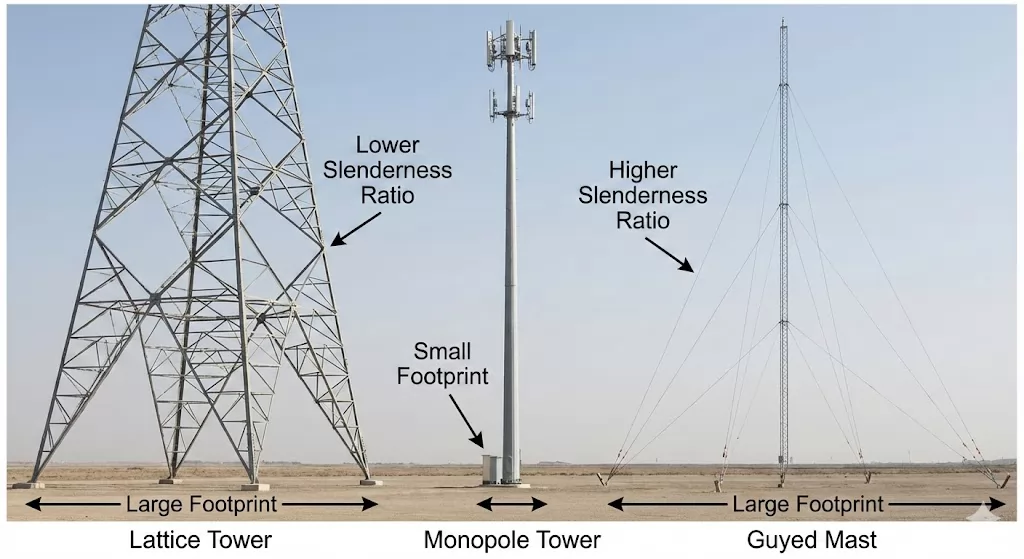
Wind load engineering sits at the core of telecommunication tower structural design.
It influences not only member strength and stability, but also long-term network reliability and upgrade flexibility.
A properly designed telecom tower must account for:
Code-defined design wind speed
Terrain and height amplification effects
Realistic antenna and equipment wind loads
Regional extreme wind conditions
Neglecting any of these factors compromises the safety and serviceability of the entire structure.
Among all environmental actions acting on a telecommunication tower, wind load is almost always the dominant design load.
Unlike conventional low-rise steel structures, telecom towers are tall, slender, and continuously exposed, making them highly sensitive to wind-induced forces throughout their entire service life.
For most telecommunication towers, wind load governs:
Member sizing
Global stability checks
Foundation design
Allowable antenna and equipment capacity
In many regions, even where seismic activity exists, wind effects still control the structural design, especially for towers above 30–40 meters in height.
From an engineering perspective, wind load on a telecom tower is not a single force but a combination of aerodynamic effects, including:
Mean wind pressure
Gust effects
Height-dependent amplification
Shape and drag characteristics of structural members and antennas
This is why accurate wind load analysis is critical for safe and economical telecom tower design.
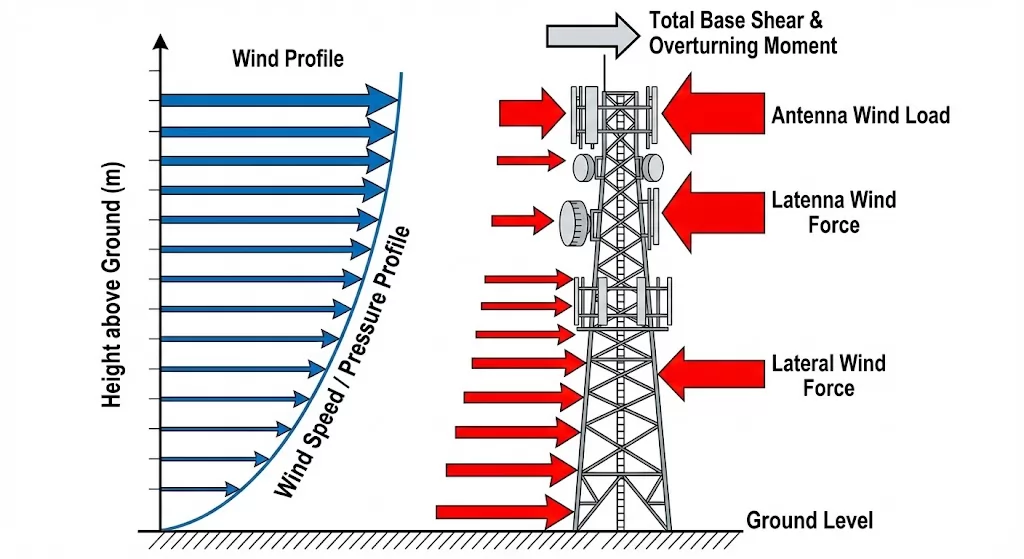
A common misconception in telecom projects is equating design wind speed with the highest recorded wind speed in a region.
In reality, design wind speed is a statistical and code-defined parameter, not a historical maximum.
Most international standards define design wind speed based on:
A specific return period (typically 50 years or 100 years)
Standardized meteorological measurements at reference height
Probabilistic risk models
For example:
TIA-222 defines basic wind speed as a 3-second gust measured at 10 m above ground in open terrain.
EN 1991-1-4 (Eurocode) uses a different averaging time and terrain categorization methodology.
As a result, the same numerical wind speed value can represent very different design conditions depending on the standard applied.
This distinction is crucial in international telecom projects, where misunderstanding wind speed definitions can lead to either:
Unsafe under-design
Excessive and unnecessary steel consumption
In practical telecom tower engineering, wind load calculation depends far more on engineering parameters than on wind speed alone.
The most influential parameters include:
Terrain roughness directly affects wind profile and turbulence intensity.
Typical terrain categories include:
Open terrain (deserts, coastal areas)
Suburban terrain
Dense urban environments
Telecommunication towers installed in open terrain often experience significantly higher wind pressures, even when nominal wind speeds are the same.
Wind pressure increases with height above ground.
For tall telecom towers, especially those exceeding 60 meters, this height-dependent amplification becomes a critical design factor.
Lattice members, tubular sections, antennas, and mounts all have different aerodynamic behaviors.
Ignoring accurate shape coefficients can lead to non-conservative wind load estimation, particularly for monopole towers.
These parameters explain why wind load calculation for telecommunication towers cannot be simplified to a single formula without risking structural reliability.
In modern telecom tower design, antennas and auxiliary equipment often contribute more wind load than the tower structure itself.
Each antenna introduces:
Projected wind area
Drag coefficient
Eccentric loading relative to the tower centerline
With the deployment of 4G and especially 5G systems, antenna sizes and quantities have increased, leading to:
Higher overall wind load
Increased torsional effects
Reduced remaining structural capacity for future upgrades
In multi-operator or shared towers, cumulative antenna wind load becomes one of the most critical limiting factors in structural verification.
For this reason, experienced engineers treat antenna wind load not as an accessory input, but as a primary design variable from the earliest stages of tower design.
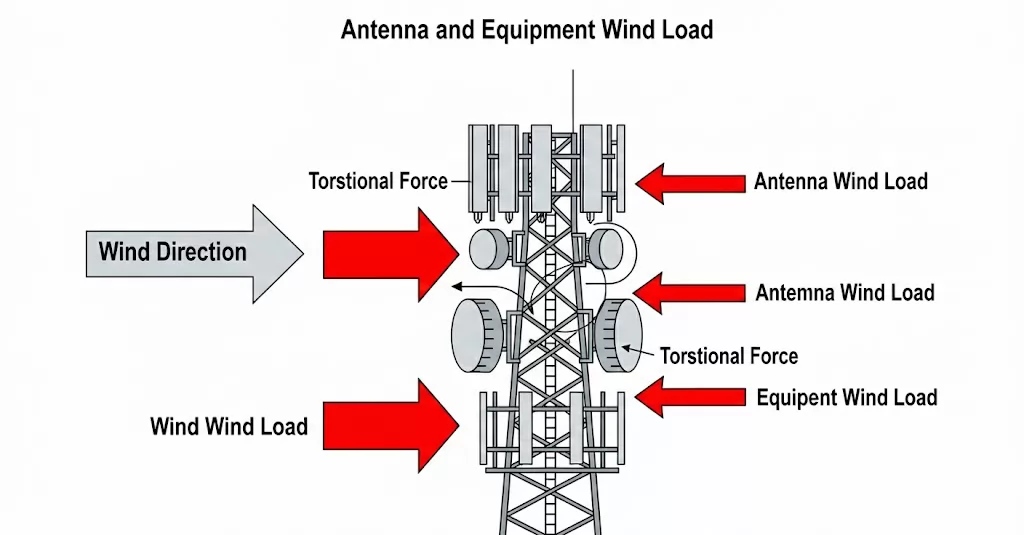
Modern telecom tower wind load analysis typically relies on specialized structural software such as:
PLS-TOWER
MS Tower
ASM Tower
These tools implement code-based wind load models and automate complex calculations across thousands of structural members.
However, software does not replace engineering judgment.
Experienced telecom structural engineers must still verify:
Correct terrain and exposure selection
Reasonable antenna modeling assumptions
Load combinations and governing cases
Blind reliance on software outputs without understanding the underlying wind load principles is a common source of design errors in telecom tower projects.
Telecommunication towers installed in extreme wind regions require additional engineering attention.
Typical high-risk zones include:
Coastal and offshore areas
Cyclone- and hurricane-prone regions
Open desert environments with low surface roughness
In these locations, wind load design may involve:
Higher importance factors
Reduced allowable deflection limits
Enhanced connection and foundation detailing
Even for towers of identical height and configuration, regional wind characteristics can lead to substantially different structural designs.
This reinforces a fundamental engineering principle:
There is no universally “standard” telecom tower wind load — only code-compliant, site-specific design.
Height fundamentally shapes the structural behavior of telecommunication towers.
As towers become taller, engineers must address:
Increased slenderness and stability risks
Stricter deflection and serviceability requirements
More complex torsional and dynamic effects
Successful telecom tower height design requires a holistic understanding of how geometry, wind load, and structural system interact over the tower’s entire lifespan.
In telecommunication tower engineering, height is never a simple geometric parameter.
As tower height increases, structural behavior changes in ways that are non-linear and often counterintuitive.
A common assumption is that doubling the height of a tower merely doubles the structural demand.
In reality, increasing tower height leads to:
Disproportionately higher bending moments at the base
Increased global flexibility
Greater sensitivity to wind-induced dynamic effects
For telecommunication towers, especially those exceeding 50–60 meters, height becomes a governing factor in both strength and serviceability design.
One of the most critical height-related parameters in telecom tower design is the slenderness ratio.
The slenderness ratio reflects the relationship between:
Effective height of the structure
Lateral stiffness provided by the structural system
High slenderness ratios increase the risk of:
Global buckling
P–Δ (second-order) effects
Sudden loss of load-carrying capacity under wind action
Monopole towers, in particular, are inherently more slender than lattice towers, which explains why monopole tower height is more strictly limited in high-wind regions.
For tall telecommunication towers, engineers must explicitly account for second-order effects to ensure global stability under design wind load combinations.
Structural safety alone is not sufficient for telecom towers.
Serviceability performance, especially deflection and rotation, plays a crucial role in maintaining network functionality.
Excessive tower deflection can result in:
Antenna misalignment
Coverage degradation
Increased maintenance requirements
Most telecom design standards impose allowable deflection limits that are often much stricter than those used for ordinary buildings.
For tall towers, deflection control frequently becomes the governing design criterion, even when member stresses remain within allowable limits.
This is particularly important for:
High-frequency antennas
Multi-band and multi-operator installations
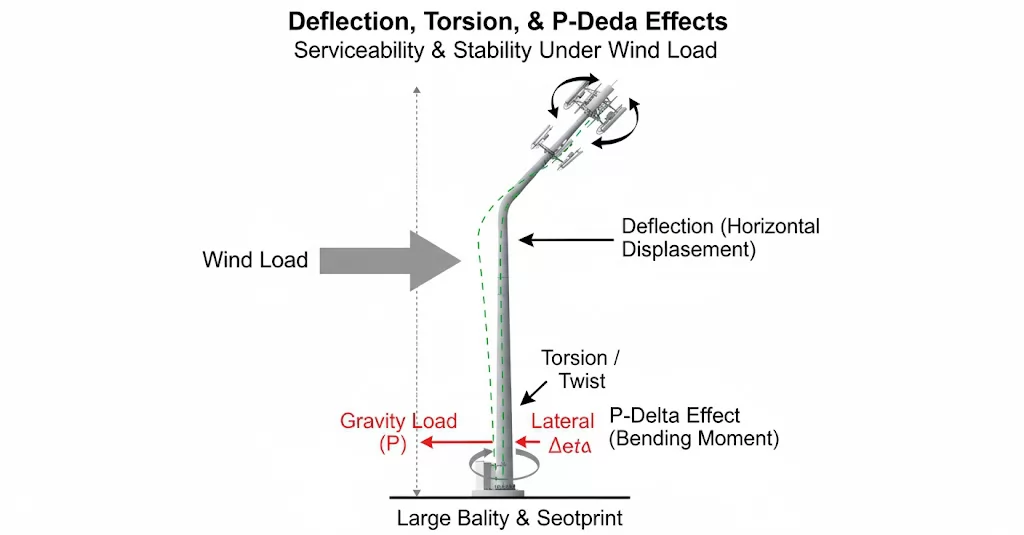
As tower height increases, torsional behavior becomes more pronounced, especially when antennas are installed asymmetrically.
Contributing factors include:
Uneven antenna distribution
Varying wind exposure at different elevations
Eccentric equipment mounting
Torsional response can significantly amplify stresses in individual members and connections, even when overall wind load appears moderate.
For this reason, telecom tower height design must consider not only global bending but also three-dimensional structural behavior under combined wind and equipment loads.
Tall telecommunication towers are inherently dynamic structures.
Wind acting on a flexible tower can induce various types of vibration, including:
Along-wind vibration
Cross-wind vibration
Vortex-induced vibration
As tower height increases, natural frequencies decrease, making tall towers more susceptible to resonance with wind-induced excitation.
Unchecked dynamic response may lead to:
Fatigue damage in members and connections
Loosening of bolts
Premature equipment failure
For towers in critical wind environments or with significant height, dynamic behavior must be evaluated as part of the overall structural design process.
From an engineering and project management perspective, maximum height is not always optimal height.
Increasing tower height affects:
Structural steel quantity
Foundation size and cost
Transportation and erection complexity
In many projects, a relatively small increase in height can result in a disproportionately large increase in total project cost.
Experienced engineers aim to optimize tower height by balancing:
Required network coverage
Structural stability
Long-term expansion capability
Budget constraints
Effective height optimization ensures both technical reliability and economic efficiency over the tower’s full service life.
Height-related behavior varies significantly between different telecommunication tower systems.
Lattice towers offer higher stiffness and redundancy, making them suitable for very tall applications.
Monopole towers provide aesthetic and space advantages but face stricter height limitations due to slenderness and deflection.
Guyed masts can reach extreme heights but require large land areas and precise tension control.
Understanding these differences is essential when selecting an appropriate tower type for height-critical projects.
Structural and material standards form the connecting framework that integrates wind load analysis and height-related structural behavior into a coherent, reliable design.
By adhering to recognized standards, telecom tower designs achieve:
Consistent safety margins
Predictable performance under wind loading
Long-term durability and adaptability
In essence, standards transform complex engineering variables into manageable, verifiable design decisions.
In telecommunication tower engineering, structural standards are not optional references — they are the foundation of safety, reliability, and legal compliance.
Unlike generic steel structures, telecom towers must:
Withstand continuous environmental loading
Maintain performance over a 20–30 year design life
Support future equipment upgrades without structural modification
Structural standards ensure that wind load assumptions, height-related effects, and material behavior are treated consistently and conservatively across all design stages.
For project owners and operators, compliance with recognized standards is also essential for:
Regulatory approval
Insurance coverage
Long-term asset valuation
Telecommunication towers are typically designed according to internationally recognized standards, depending on project location and contractual requirements.
TIA-222 is one of the most widely used standards for telecommunication tower design worldwide.
Key characteristics include:
Detailed wind load modeling
Explicit treatment of tower height and slenderness
Clear serviceability and strength limit states
TIA-222 is commonly specified in international EPC and operator-driven projects due to its clarity and practical engineering approach.
The Eurocode framework provides a comprehensive set of standards covering:
Wind actions (EN 1991-1-4)
Steel structure design (EN 1993)
Eurocodes are frequently used in European, African, and Middle Eastern projects, especially where local regulations reference EU norms.
ISO standards often supplement national codes by defining:
Material quality requirements
Fabrication and inspection procedures
Quality management systems
In many international telecom tenders, ISO compliance serves as a baseline qualification requirement rather than a design code.
Structural standards do not treat wind load and height as isolated parameters.
Instead, they define interdependent rules governing how these factors interact.
Typical standard provisions include:
Height-dependent wind pressure coefficients
Importance factors for critical infrastructure
Deflection and rotation limits linked to tower height
As tower height increases, standards generally impose:
Stricter serviceability limits
More conservative stability checks
Enhanced safety margins
This integrated approach ensures that tall telecommunication towers remain both safe and functional under long-term wind exposure.
Material selection plays a critical role in telecom tower structural performance.
Commonly used steel grades include:
ASTM A36, A572
EN S235, S355
GB Q235, Q355
Higher-strength steels allow for:
Reduced member sizes
Lower overall tower weight
Improved transport and erection efficiency
However, higher strength does not automatically mean better performance.
Design standards impose limits on slenderness, ductility, and weldability that must be respected regardless of material grade.
Experienced engineers select steel grades based on structural behavior, availability, and lifecycle considerations, not solely on yield strength.
Connections are often the most critical — and vulnerable — components of telecommunication towers.
Design standards define:
Bolt grades and pretension requirements
Weld types and inspection criteria
Connection detailing rules to prevent fatigue and corrosion
In tall towers subjected to cyclic wind loading, connection performance governs long-term durability.
Even when primary members are adequately designed, poor connection detailing or substandard workmanship can compromise the entire structure.
This is why telecom tower standards emphasize:
Certified materials
Controlled fabrication processes
On-site quality inspection
Telecommunication towers are expected to operate for decades in aggressive environments.
Structural standards therefore include requirements for:
Corrosion allowance
Protective coatings
Minimum galvanization thickness
Hot-dip galvanization, performed in accordance with recognized standards, remains the most common corrosion protection method for telecom towers.
In coastal, industrial, or high-humidity regions, enhanced protection systems may be required to achieve the specified design life.
A properly specified corrosion protection system ensures that structural capacity is preserved over time, not just at initial installation.
Beyond engineering performance, standards compliance serves as a critical risk mitigation tool.
For telecom tower projects, non-compliance can lead to:
Regulatory rejection
Project delays
Increased liability exposure
Conversely, documented compliance with recognized standards provides:
Clear technical accountability
Transparent design justification
Confidence for operators, investors, and authorities
This is particularly important in international projects, where multiple stakeholders rely on standardized engineering benchmarks.
Safe and effective telecommunication tower design is the result of three inseparable factors:
Accurate wind load assessment
Clear understanding of height-driven structural behavior
Strict compliance with structural and material standards
Only when these elements are addressed together can a telecom tower reliably serve its network function over decades of operation.
This article has been prepared to provide a comprehensive, engineering-focused overview of telecommunication tower design, with particular emphasis on:
Wind load engineering principles
Height-related structural behavior
Compliance with international structural and material standards
All technical guidance and examples presented are based on recognized engineering practices, international design codes (such as TIA-222, EN 1991-1-4, and EN 1993), and structural analysis principles commonly applied by licensed civil and structural engineers in the telecommunication industry.
The content is intended to serve as an educational and professional reference for:
Telecommunication network operators
EPC contractors and structural engineers
Government agencies and regulatory bodies
Technical procurement and project management teams
The information provided reflects practical engineering experience in designing, analyzing, and reviewing telecommunication towers across multiple types and geographies.
It incorporates lessons learned from:
High-wind zone tower design
Multi-antenna and multi-operator installations
Long-term serviceability and structural durability requirements
By presenting real engineering considerations, material selection criteria, and standard compliance requirements, this article demonstrates expertise grounded in professional practice, rather than generic theory.
The article references widely recognized codes and standards rather than proprietary methodologies.
No commercial products or manufacturers are endorsed; the focus remains strictly on engineering principles.
All design considerations are discussed in neutral, evidence-based terms, ensuring objective guidance for readers.
While this article provides technical insight into telecom tower design, it is not a substitute for professional engineering consultation or certification.
Specific telecommunication tower projects should always be designed and verified by:
Licensed structural engineers
Certified civil engineers familiar with local regulations
Qualified design review boards
Design decisions must be based on site-specific conditions, load assessments, local codes, and project requirements. The authors and publishers assume no liability for errors, omissions, or decisions made based on this article.
Readers are encouraged to use this article as:
A foundation for understanding structural design challenges in telecommunication towers
A reference for wind load, height, and standards considerations
A guide to aligning design decisions with recognized engineering codes
For any project requiring construction, installation, or regulatory approval, professional engineering services must be retained to ensure safety, compliance, and long-term performance.
Wind load refers to the lateral force exerted by wind on a telecommunication tower and its installed equipment.
In telecom tower design, wind load typically governs structural sizing because towers are tall, slender, and continuously exposed. Wind load includes mean wind pressure, gust effects, height amplification, and aerodynamic behavior of antennas and structural members.
Wind load calculation for telecom towers is performed according to recognized structural standards such as TIA-222 or EN 1991-1-4.
The calculation considers design wind speed, terrain category, height factor, shape coefficients, and antenna projected area. Specialized structural software is commonly used, but engineering judgment remains essential.
A telecommunication tower is not designed for a single “maximum wind speed.”
Instead, it is designed for a code-defined design wind speed associated with a specified return period (commonly 50 or 100 years). The actual wind resistance depends on tower height, structure type, terrain exposure, and installed equipment.
As telecommunication tower height increases, structural demands grow non-linearly.
Higher towers experience greater bending moments, increased deflection, and stronger dynamic effects. Height also amplifies wind load and stability concerns, making it a critical parameter in telecom tower structural design.
In many regions, yes.
For most telecommunication towers, especially those over 30–40 meters tall, wind load governs design more often than seismic load. Earthquake effects may become critical in high-seismic zones, but wind typically controls global stability and serviceability.
The slenderness ratio describes the relationship between a tower’s height and its lateral stiffness.
High slenderness ratios increase the risk of buckling and excessive deflection. Monopole towers generally have higher slenderness ratios than lattice towers, which limits their maximum practical height in high-wind areas.
Deflection limits vary by design standard and project requirements.
Telecom standards usually impose stricter deflection limits than ordinary buildings to prevent antenna misalignment and network performance degradation. Serviceability often governs the design of tall towers.
Antennas contribute significantly to wind load through their projected area and drag characteristics.
In modern telecom towers, antenna wind load can exceed the wind load on the tower structure itself. Multiple antennas and asymmetric layouts also introduce torsional effects that must be accounted for in design.
Monopole towers are structurally more slender and flexible than lattice towers.
As height increases, monopoles experience higher deflection and stability challenges under wind loading. Lattice towers provide greater stiffness and redundancy, making them more suitable for taller applications.
Commonly used standards include:
TIA-222 for telecom towers in the United States and international projects
EN 1991 / EN 1993 (Eurocodes) for European and many international projects
ISO standards for material quality and fabrication requirements
The applicable standard depends on project location, regulatory requirements, and contractual specifications.
Compliance with recognized structural standards ensures safety, reliability, and legal defensibility.
Non-compliance can lead to regulatory rejection, insurance issues, and increased structural risk. Standards also provide a common technical framework for international telecom projects.
Telecommunication towers commonly use structural steels such as ASTM A36, A572, EN S235, S355, and GB Q235, Q355.
Material selection depends on strength requirements, availability, weldability, and long-term durability rather than yield strength alone.
Most standards require corrosion protection measures such as hot-dip galvanization to ensure a 20–30 year design life.
In aggressive environments, enhanced coating systems may be specified to maintain structural capacity over time.
Yes, but only if future loading scenarios are considered during the initial design.
Design standards allow for reserve capacity, but excessive future equipment additions without structural verification can compromise safety and performance.
Engineers optimize tower design by balancing wind load, height, structural behavior, and standards compliance.
Overdesign increases cost without proportional benefit, while under-design increases risk. Effective telecom tower design focuses on long-term reliability and lifecycle efficiency.






Procurement guide for engineers sourcing radar towers: technical specs, supplier evaluation questions, RFQ checklist, and factory trial assembling explained. By XH Tower.


