



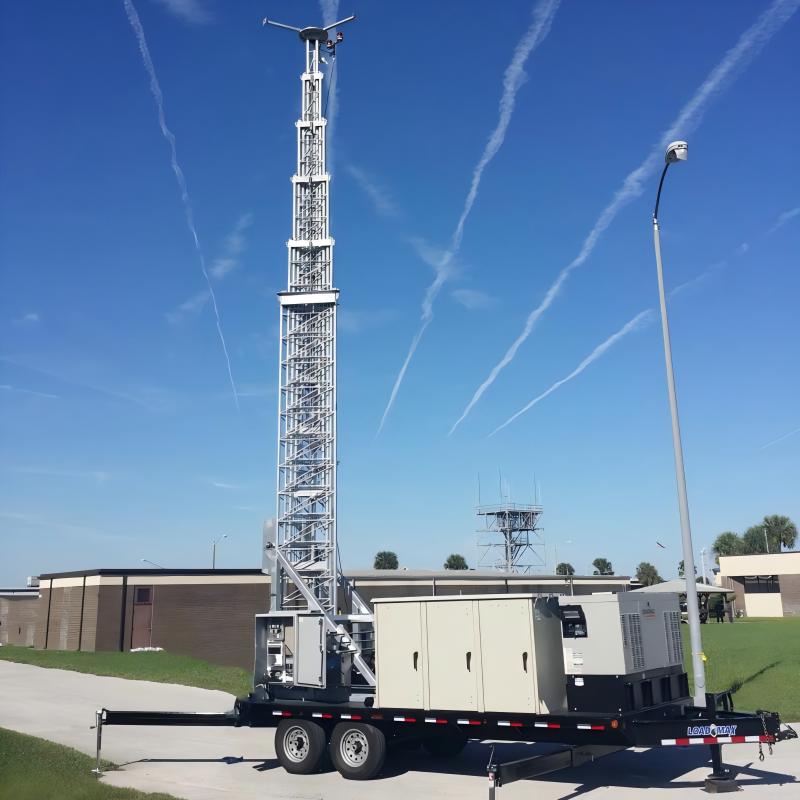
The robust solution for high-capacity event coverage and long-term temporary needs.
Built on a DOT-approved heavy-duty trailer with hydraulic stabilization jacks. Features a walk-in, air-conditioned equipment shelter for multiple radio racks and integrated, high-output diesel generators for weeks of autonomous operation. Supports 3G/4G/5G deployment.
Key Specifications
Mast Type: Telescoping Guyed/Self-Supported Mast
Antenna Height: 15 – 30 meters
Equipment Shelter: Vandal-Proof, IP55 Rated, with HVAC
Power: Onboard 15kW+ Generator & Fuel Tank
Best for: Major Festivals, Sports Events, Network Bridging
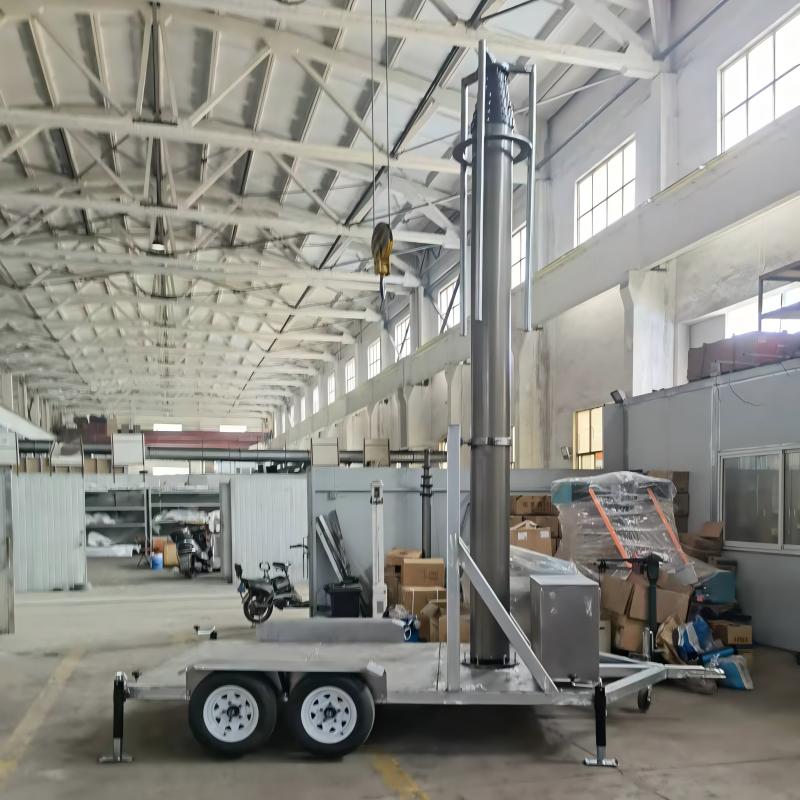
Compact footprint and ultra-fast setup for disaster recovery and small cell densification.
A smaller, more agile Cellular on Wheels unit towable by a standard pickup truck. Features a smaller equipment enclosure and a lightweight, self-guying mast (pneumatic or winch-driven). Ideal for rapid mobilization in tight urban areas or difficult-to-access disaster zones.
Key Specifications
Mast Type: Pneumatic or Manual Winch Telescoping
Antenna Height: 10 – 18 meters
Mobility: Easily Towable by ½ Ton Truck
Setup Time: Less than 15 minutes (minimal guying required)
Best for: Disaster Recovery (D-RAN), Temporary Small Cell Coverage
| Parameter | Specification (Based on TIA Standards & Industry Practice) |
|---|---|
| Design Standard | ANSI/TIA-222 (Structural), DOT/ECE (Trailer Roadworthiness) |
| Tower Type | Telescoping Mast (Lattice or Monopole style) |
| Operational Wind Load | Up to 80 - 120 km/h (Dependant on mast height and payload) |
| Stabilization System | Hydraulic/Manual Outriggers and Leveling Jacks |
| Antenna Payload Capacity | 150 kg to 500 kg (High capacity for multi-sector 5G RRUs) |
| Equipment Protection | Insulated, Vandal-proof, IP55-rated Enclosure |
| Generator Output | Diesel, 5 kW to 30 kW (with automated transfer switch) |
The Cellular on Wheels platform is essential for optimizing capacity and ensuring business continuity across various critical scenarios.
Deployed during large concerts, sporting events, or trade shows to offload dense data traffic and prevent network congestion, supporting thousands of concurrent users.
Provides immediate and critical communication channels (FirstNet, public safety bands) when permanent infrastructure is compromised by natural disasters or power outages.
Used to maintain seamless service during the lengthy construction or upgrade phases of permanent cell sites (COW replaces a permanent tower during maintenance).
Enables carriers to test new antenna arrays, 5G configurations, or coverage patterns in live environments before committing to permanent CAPEX investment.
The core advantage of Cellular on Wheels is the fully integrated, one-touch deployment system designed for single-person operation.
Our mobile platforms are engineered to meet global telecom structural codes and road safety requirements for confident, cross-border use.
TIA-222-H or TIA-322 (Mobile Lattice and Tower Systems)
Compliant with local road regulations (e.g., DOT, ECE) including braking and lighting systems.
IP55 (Dust and Water protection) / ISO 9001:2015 (Quality Management)
We offer fully customized COW solutions to integrate your preferred RF equipment, specific power requirements, and logistical needs.
Submit your project specifications and foundation requirements today for a technical review and manufacturing proposal.

XH TOWER strictly implements GB8702-2014 "Electromagnetic Environment Control Limits", and the measured value of the base station antenna radiation power density is ≤0.08W/m² (only 40% of the national standard limit).
By optimizing the antenna tilt angle (electronic downtilt angle 0-15° adjustable) and vertical lobe width (6°-90°), the radiation value 10 meters away from the ground is ensured to be attenuated to below 0.01W/m².
By optimizing the antenna tilt angle (electronic downtilt angle 0-15° adjustable) and vertical lobe width (6°-90°), the radiation value 10 meters away from the ground is ensured to be attenuated to below 0.01W/m².
For residential sites, XH TOWER can also provide a real-time radiation monitoring data disclosure platform, where users can scan the code on their mobile phones to view dynamic radiation values and eliminate public concerns.
Low torsional stiffness: an L-shape is unsymmetrical, so it resists twisting poorly versus closed or symmetric sections. This matters where torsion or lateral buckling is possible.
Direction-sensitive strength: one leg carries more of the load depending on orientation — designers must account for eccentric loads and local bending.
Less material efficiency: for the same weight, I-sections or tubular sections usually provide higher moment of inertia (stiffness) and therefore carry larger bending loads more efficiently.
Connection and fatigue issues: lattice/angle assemblies need many bolted/welded connections that concentrate stress and require inspection/maintenance; fatigue cracks can initiate at bolt holes or weld toes.
Aesthetic & aerodynamic drawbacks: open lattice made from angles increases wind profile and creates more surfaces to corrode or collect dirt compared to smooth tubular members.
angle steel is excellent for cost-sensitive, short-to-medium spans and lattice towers, but for long spans, heavy bending/torsion, or low-maintenance needs, prefer I-sections, box/tubular sections, or engineered hollow sections.
Geological requirements for signal towers focus on the soil and subsurface conditions to ensure structural stability. A geotechnical study, including a soil test and boring logs, is mandatory to determine the site's ability to support the tower and withstand environmental forces like wind and earthquakes. The investigation assesses foundation rock types, groundwater levels, and slope stability to inform the appropriate design for the tower's footing and overall structure. Geological requirements for signal towers focus on the soil and subsurface conditions to ensure structural stability. A geotechnical study, including a soil test and boring logs, is mandatory to determine the site's ability to support the tower and withstand environmental forces like wind and earthquakes. The investigation assesses foundation rock types, groundwater levels, and slope stability to inform the appropriate design for the tower's footing and overall structure.


